

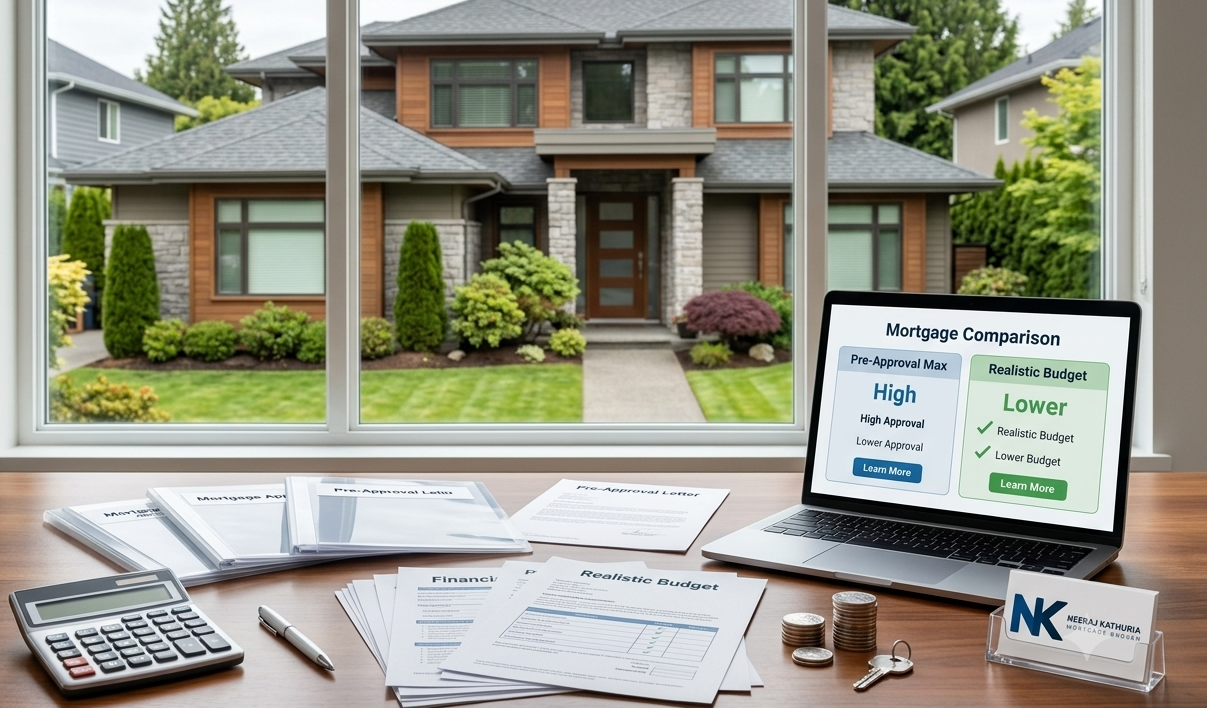
Getting a mortgage pre-approval can make the home-buying process feel much easier. You receive an estimated borrowing amount, get a clearer idea of what a lender may be willing to offer, and can start looking at properties with greater confidence.
But there is an important distinction many buyers overlook:
Your mortgage pre-approval Surrey amount is not necessarily the same as the amount you should spend on a home.
A lender’s pre-approval primarily answers the question, “How much might you qualify to borrow?” Your personal budget needs to answer a different question: “How much can I comfortably afford while still managing the rest of my financial commitments?”
Understanding that difference can help Vancouver-area and Surrey homebuyers avoid stretching their finances simply because a lender has indicated that they may qualify for a larger mortgage.
What Does a Mortgage Pre-Approval Actually Tell You?
A mortgage pre-approval gives you an estimate of how much financing you may qualify for based on information such as your income, debts, credit profile, down payment, and the lender’s qualification criteria.
It can be useful when shopping for a home because it gives you a starting point for understanding your potential borrowing capacity.
However, pre-approval is generally not a guarantee that every property within that amount will be affordable for you.
Your eventual mortgage approval can still depend on the specific property, updated financial information, documentation, lender policies, and other factors.
More importantly, the maximum amount you can borrow may be higher than the amount that makes sense for your household budget.
Why Your Pre-Approval Amount Can Be Higher Than Your Comfortable Budget
Imagine a buyer receives a mortgage pre-approval that suggests they could borrow $700,000.
That does not automatically mean they should purchase a $700,000 home.
A mortgage payment is only one part of the cost of homeownership.
Your real budget may also need to account for:
- Property taxes
- Home insurance
- Utilities
- Strata fees, if applicable
- Maintenance and repairs
- Closing costs
- Moving expenses
- Childcare and transportation
- Existing loans or credit obligations
- Emergency savings
- Retirement and other financial goals
Once these expenses are considered, the amount that feels comfortable each month may be considerably lower than the maximum borrowing amount shown on a pre-approval.
Pre-Approval vs. Your Real Home-Buying Budget
Think of the two numbers as serving different purposes.
Pre-approval amount:
An estimate of how much you may be able to borrow based on lender qualification criteria.
Home-buying budget:
The amount you can realistically spend while maintaining a sustainable monthly financial plan.
This distinction is especially important because lenders evaluate affordability using standardized qualification rules. Your personal financial priorities may be more conservative.
For example, you may qualify for a larger mortgage but prefer to keep your monthly housing costs lower so you can continue saving, travel, handle unexpected repairs, or invest for the future.
What Expenses Should You Include in Your Real Budget?
Before deciding how much home you can afford, calculate the total cost of owning the property—not just the mortgage payment.
Mortgage Payment
Your mortgage payment will usually be the largest recurring housing expense, but it should not be considered in isolation.
Your payment can vary depending on the loan amount, interest rate, amortization period, and other mortgage terms.
Property Taxes
Property taxes vary by municipality and property value.
When comparing homes, include the estimated annual property tax in your monthly affordability calculation.
Home Insurance
Insurance is another recurring expense that should be included in your overall housing budget.
The cost can vary depending on the property, coverage, location, and other factors.
Strata Fees
If you’re considering a condominium or strata property, monthly strata fees can have a meaningful effect on affordability.
A property with a lower purchase price but high monthly strata fees may have a different overall cost than a slightly more expensive property with lower ongoing fees.
Maintenance and Repairs
Homeownership inevitably comes with maintenance costs.
A roof, furnace, plumbing system, appliances, windows, or other major components may eventually require repair or replacement.
A responsible home-buying budget should leave room for these unexpected expenses.
Closing Costs
Your purchase budget should also account for expenses due at or around closing.
Depending on your circumstances and the property, these can include legal or notary fees, inspection costs, appraisal-related expenses, property transfer tax where applicable, adjustments, and moving costs.
This is why using your entire available cash toward the down payment may not always be the best approach.
How Much Should You Actually Spend After Getting Pre-Approved?
There is no universal percentage that applies to every buyer.
Instead, start with your comfortable monthly housing cost and work backward.
Consider your current take-home income, recurring expenses, debts, savings goals, and expected homeownership costs.
Then compare different mortgage scenarios rather than automatically shopping at the top of your pre-approved range.
A mortgage calculator can help you test different purchase prices, down payments, interest rates, and amortization periods. However, the calculator should be used as a planning tool rather than a substitute for personalized mortgage advice.
Why Your Down Payment Changes the Picture
Your down payment affects more than the amount you borrow.
A larger down payment can reduce the mortgage amount and may change your monthly payment. But putting every available dollar into the down payment can leave you with limited cash reserves after closing.
For example, homeowners may need funds for:
- Moving expenses
- Immediate repairs
- Furniture or appliances
- Emergency savings
- Renovation work
- Property-related fees
The ideal balance depends on your overall financial situation.
The goal should not simply be to maximize the down payment. It should be to purchase a home while maintaining a reasonable financial cushion.
What About First-Time Homebuyers?
The difference between pre-approval and affordability can be particularly important for first-time buyers.
Someone purchasing a home for the first time may be focused heavily on getting approved and finding out how much they can borrow.
But first-time buyers should also consider what their finances will look like after the purchase.
A dedicated First-Time Homebuyer Mortgage Surrey strategy can help buyers understand available mortgage options, down payment considerations, and the broader costs associated with becoming a homeowner.
Instead of asking only:
“How much will the bank lend me?”
A better question is:
“What monthly housing cost can I comfortably maintain for the next several years?”
Why Interest Rates Matter to Your Budget
Your pre-approval is based on specific assumptions about your mortgage terms and qualification.
But interest rates can change, and your eventual mortgage payment will depend on the rate and mortgage structure you actually receive.
Even a relatively small change in the interest rate can affect the total interest paid and the monthly cost of borrowing.
That is why it can be useful to stress-test your budget.
Ask yourself:
Would this home still be comfortable if my future mortgage payment increased?
Planning for some financial flexibility can reduce the risk of becoming house-rich but cash-poor.
Don’t Forget Your Other Debts
Your mortgage should fit alongside your existing financial commitments.
Car loans, student loans, credit card balances, lines of credit, personal loans, and other recurring obligations can all affect your monthly cash flow.
A lender may consider these debts when assessing qualification, but you should also consider how they affect your personal comfort level.
Two households with identical incomes can have very different home-buying budgets if their monthly debt obligations are different.
Your Pre-Approval Is a Starting Point, Not a Spending Target
One of the biggest mistakes buyers can make is treating their maximum pre-approved amount as their target purchase price.
For example:
Pre-approved borrowing capacity: $700,000
Preferred mortgage: $600,000
Comfortable purchase price: potentially lower or higher depending on down payment and other costs
The numbers above are only an illustration. The important point is that your maximum qualification and personal budget do not have to be identical.
You are allowed to choose a home that costs less than your maximum approval.
In fact, doing so may give you more financial flexibility.
How a Mortgage Broker Can Help You Look Beyond the Maximum
A mortgage broker can help you compare mortgage options and understand how different borrowing scenarios may affect your finances.
Instead of focusing solely on the highest possible mortgage amount, a conversation can cover factors such as:
- Purchase price
- Down payment
- Interest rate
- Mortgage term
- Amortization
- Monthly payment
- Existing debts
- Property type
- Closing costs
- Longer-term financial goals
This broader approach can make your home search more realistic.
A professional Mortgage Broker Surrey buyers can speak with can also help explain mortgage options based on their individual circumstances.
How to Build a More Realistic Home-Buying Budget
Before making an offer, consider following this five-step approach:
Step 1: Start With Your Monthly Income
Determine how much income is realistically available after taxes and other deductions.
Step 2: List Your Existing Monthly Obligations
Include loans, credit payments, insurance, transportation, childcare, subscriptions, and other recurring expenses.
Step 3: Estimate the Full Cost of Homeownership
Add your projected mortgage payment, property taxes, insurance, strata fees where applicable, utilities, and maintenance.
Step 4: Protect Your Emergency Fund
Don’t assume every dollar available should go toward the purchase.
Maintain an appropriate financial reserve for unexpected expenses.
Step 5: Compare Multiple Purchase Scenarios
Use a Mortgage Calculator to compare different home prices and down payments.
For example, compare how your monthly budget changes if you purchase at $500,000, $550,000, or $600,000 rather than looking only at the maximum amount you were pre-approved for.
What If Your Budget Is Lower Than Your Pre-Approval?
That’s completely normal.
A pre-approval is not a requirement to borrow the maximum amount available.
Choosing a lower purchase price can provide benefits such as:
- Lower monthly payments
- More room for savings
- Greater flexibility for repairs
- Less financial pressure
- More capacity for future goals
The right mortgage is not necessarily the largest mortgage you can qualify for. It is the one that fits your financial circumstances and long-term plans.
A mortgage pre-approval can be an important first step toward buying a home, but it should not become your spending target. The amount a lender may approve is based on qualification criteria, while your personal home-buying budget should reflect the complete cost of homeownership and the lifestyle you want to maintain.
Before making an offer, look beyond the mortgage number. Consider property taxes, insurance, strata fees, maintenance, closing costs, existing debts, savings, and future financial goals. Comparing different scenarios can help you find a purchase price that feels sustainable rather than simply achievable.
If you’re unsure how to turn your mortgage pre-approval into a realistic home-buying budget, Mortgage Broker – Neeraj Kathuria can help you review your mortgage options and understand the numbers before you make a major financial commitment. Contact Neeraj Kathuria for personalized mortgage guidance.
Frequently Asked Questions
Is my mortgage pre-approval the maximum amount I should spend on a home?
No. A pre-approval indicates how much you may qualify to borrow, but it does not determine what you should comfortably spend. Your personal budget should also account for taxes, insurance, maintenance, debts, savings, and other expenses.
Why is my mortgage pre-approval higher than what I can comfortably afford?
Lenders assess borrowing capacity using qualification criteria that may not fully reflect your personal financial priorities. Your household expenses, lifestyle goals, savings plans, and preferred financial cushion can make your comfortable budget lower than your maximum approval.
Should I use my entire pre-approved mortgage amount?
Not necessarily. You can choose a home below your maximum borrowing capacity. Purchasing below your maximum may leave more room for savings, emergencies, repairs, and other financial goals.
Can a mortgage calculator tell me how much house I can afford?
A mortgage calculator can help estimate payments and compare different borrowing scenarios, but it does not provide a complete affordability assessment. You should also consider taxes, insurance, maintenance, strata fees, existing debts, closing costs, and your personal financial goals.
Can a mortgage broker help me determine my real home-buying budget?
Yes. A mortgage broker can help you understand different mortgage scenarios and how factors such as down payment, interest rate, term, amortization, and purchase price affect your borrowing costs. A personalized discussion can help you look beyond your maximum pre-approval amount.